


3-in-1 Alternative Energy Car DIY STEM Kit
$19.99$14.95
Posted on: Jan 25, 2011
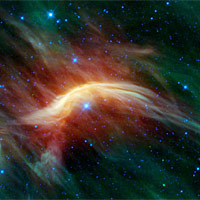
The blue star near the center of this image is Zeta Ophiuchi. When seen in visible light it appears as a relatively dim red star surrounded by other dim stars and no dust. Image credit: NASA/JPL-Caltech/UCLA
A massive star flung away from its former companion is plowing through space dust. The result is a brilliant bow shock, seen here as a yellow arc in a new image from NASA's Wide-field Infrared Survey Explorer, or WISE.
The star, named Zeta Ophiuchi, is huge, with a mass of about 20 times that of our sun. In this image, in which infrared light has been translated into visible colors we see with our eyes, the star appears as the blue dot inside the bow shock.
Zeta Ophiuchi once orbited around an even heftier star. But when that star exploded in a supernova, Zeta Ophiuchi shot away like a bullet. It's traveling at a whopping 54,000 miles per hour (or 24 kilometers per second), and heading toward the upper left area of the picture.
As the star tears through space, its powerful winds push gas and dust out of its way and into what is called a bow shock. The material in the bow shock is so compressed that it glows with infrared light that WISE can see. The effect is similar to what happens when a boat speeds through water, pushing a wave in front of it.
This bow shock is completely hidden in visible light. Infrared images like this one from WISE are therefore important for shedding new light on the region.
JPL manages and operates WISE for NASA's Science Mission Directorate, Washington. The principal investigator, Edward Wright, is at UCLA. The mission was competitively selected under NASA's Explorers Program managed by NASA's Goddard Space Flight Center, Greenbelt, Md. The science instrument was built by the Space Dynamics Laboratory, Logan, Utah, and the spacecraft was built by Ball Aerospace & Technologies Corp., Boulder, Colo. Science operations and data processing take place at the Infrared Processing and Analysis Center at the California Institute of Technology in Pasadena. Caltech manages JPL for NASA.